Electricity tariff myths busted and misinformation fact checker
03 August 2021
The City of Cape Town would like to correct some of the misinformation about its electricity tariffs that are being driven by some groups.
- Customers are seeing the impact of the massive Eskom-driven electricity increases.
- It now costs municipalities 17,8% more to buy power from Eskom. The majority of the City’s electricity tariff income is used to buy power from Eskom, and now at higher prices. The rest of the tariff income goes for the maintenance, investment and operations of the City’s network. This is where the City has some direct cost control and has managed to absorb as much of the cost of the steep Eskom increase as was possible without impacting on service delivery.
- It is impossible to absorb the full extent of such massive increases, although the City has done its best. The City was compelled to implement a 13,48% electricity increase from 1 July 2021 as was communicated in June. This is directly because of the Eskom increases.
- Still the City has absorbed more of the price hike than any other metro in South Africa – where the average increases are 14,59%.
- The income from tariffs is used to cover the cost of providing the service. If the City does not get the income from the tariffs, it cannot deliver the services.
- The tariffs reflects the cost of providing electricity – so it is the current cost of electricity provision and it is not cheap to generate and supply electricity as it stands.
- Assistance is available for struggling residents on a case-by-case basis. But the City cannot afford to provide free electricity or to offer blanket relief to everyone regardless of the circumstances of customers.
- The City of Cape Town does not have the most expensive tariffs in the country. Far from it. Although it is not an easy comparison to make as there are different tariff bands and customer bases for all these metros, if you are supplied by the City of Cape Town, including the fixed component of the tariff, you still generally receive more units than in Joburg, especially when you use less electricity. For example, for the City of Joburg, the equivalent fixed charges per month is R768,21 (incl. VAT). This does result in lower per kWh charges, so which metro is cheaper depends completely on the amount of energy consumed – again, electricity is cheaper for consumers in Cape Town who use less electricity. The City thus always actively encourages customers to use less and pay less (see the myth busters below).
- The fixed charge is an established part of tariffs, not only in Cape Town but also in the rest of the country, as it ensures that income is stable, irrespective of how much or how little is used. This enables a service provider such as the City to provide reliable services. The City’s fixed charge as part of the electricity tariff was approved some years ago. It is not new.
- The City of Cape Town does not have the most expensive tariffs when one includes the fixed charge part of the tariff. Far from it. Although it is not a straightforward comparison to make as there are different tariff bands and customers bases for all these metros, if you are supplied by the City of Cape Town including the fixed component of the tariff, you still generally receive more units than in Joburg especially when you use less. For example, for the City of Joburg, the equivalent fixed charges per month is R768,21 (incl. VAT). This does result in lower per kWh charges, so which metro is cheaper depends completely on the amount of energy consumed – again lower consumers will pay less in Cape Town. The City thus always actively encourages customers to use less and pay less (see the myth busters below).
- The City’s electricity tariffs are legal. There is no unlawful addition to the tariff schedule for the 2021 Financial Year. Those claiming this are spreading misinformation about the tariffs.
- The ‘unregulated’ tariffs have always formed part of the overall tariff paid by customers, but were separated out of the tariff a few years ago as a result of a Nersa decision that these do not form part of their mandate to approve. NOTE: These tariffs are still required to be approved by Council in terms of the Municipal Finance Management Act and are subject to any norms and standards as imposed by the Minister of Finance in terms of the Municipal Fiscal Powers and Functions Act. City tariffs are thus approved in terms of the relevant processes and legislation of South Africa. To claim otherwise, is spreading misinformation.
Help and deductions for arrears
The City understands the plight of many customers who have been severely affected by the Covid-19 pandemic and lockdown and has availed assistance on a case-by-case basis. Separate indigent and pensioner rates relief is also available.
In terms of the City’s Credit Control and Debt Collection Policy, deductions for municipal arrears debt via electricity purchases, may be made if after warnings and notification to the debtor no action has been taken by the debtor to approach the City for assistance and to agree to a valid payment arrangement.
Instead of disconnecting the electricity supply (as happens with a non-prepaid electricity meter), deductions (when purchasing electricity) only happens if:
- There is no payment arrangement in place despite warnings and notifications.
- There is a payment arrangement in place, but it is not valid as it is not being adhered to by paying in full the monthly agreed-to payments and keeping to the agreement.
- Ad hoc payments are being made but there is no formal arrangement with the City.
- If an account possibly has a tampering charge on it from a previous investigated tampering incident, that would be deducted via the electricity purchase, where relevant.
Extract from the policy:
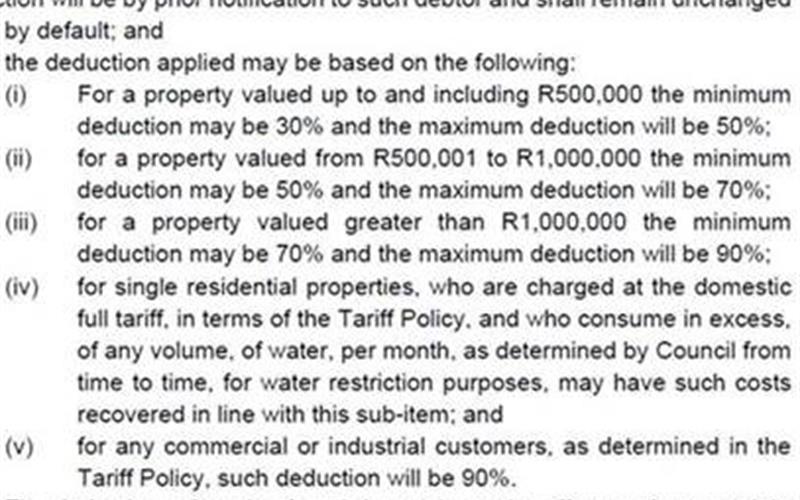
About 40% of people in Cape Town get support with rates and services, and City rentals.
Customers will notice the following in their July and August bills:
• Minimum required average rates and tariff adjustments.
• Electricity price adjustment due to the large Eskom-driven increase of 17,8% to municipalities, affecting customers.
• Winter equals higher electricity usage due to space and additional geyser heating which leads to higher bills.
• Covid-19 household impact: more people in the home, generally for longer periods of time, leading to higher electricity usage, and thus higher bills.
Common myths busted and how buying units in the right way can reduce costs:
| MYTH | TRUTH |
| You should buy units on the 1st of the month if you want to get the full free units, otherwise the amount you get drops throughout the month. | You don't have to buy on the 1st of the month to get free units. Free units or free basic electricity is only applicable to customers on the Lifeline Tariff. Two free allocations are applied depending on the average level of consumption: an allocation of 60 units if you use less than 250 kWh per month on average OR 25 units if you use between 250 kWh and 450 kWh per month. Free units are granted on your first purchase of every calendar month, irrespective of when that is. |
| You should buy units on the 1st of the month because the rate per unit increases as the month goes on. | It isn't cheaper to buy on the 1st of the month. The City has an inclining block tariff which is refreshed every month, so if you only purchase in the first block, you pay the same amount; the higher cost of the second block kicks in once you reach the threshold of the first block. |
| You should buy as many units as you can in one go as they are cheaper in bulk. | Buying in bulk is not cheaper! Only buy what you need! You should only buy what you need in a given month – this will keep your costs down. When buying in bulk, you move onto the second block for units above the monthly usage threshold, which is more expensive. So, buying in bulk can be considerably more expensive. |
| You should rather make many small purchases in the month so that you stay within the cheapest block rate with each purchase. | Many small purchases could cost you more! The rate applied on each purchase is dependent on previous purchases in the month (i.e. it accumulates). Once the first block is bought up, you automatically move to the second block irrespective of the number of times you made a purchase. |
| Monthly totals are based on how much you use, not on how many units you buy at a time. | It is about how many units you buy. Prepaid meters are not intelligent meters. The meter merely accepts tokens and then reduces as the units are consumed. When buying electricity at a vending station, our computer server determines what has been bought previously in the month and what block rate to apply to the purchase of electricity for the given amount. |
| You pay more per unit when you use electricity in winter months or during peak hours in the evening. | The price is the same no matter the time or season.
Residential tariffs do not differ according to the time of the day or the year when electricity is consumed. |
Update
City’s categorical response to statement by the StopCoCT Facebook group – in bold:
PRESS RELEASE BY STOP COCT
4 August 2021
REPLY TO CLAIMS MADE BY THE CITY OF CAPE TOWN REGARDING THEIR TARIFF SETTING POLICIES
Once again, the City of Cape Town reacts and take to the printed media in its inflexible and “we can do no wrong” entrenched manner.
The City of Cape Town blames Eskom for COCT’s tariff of R2.73 (incl. VAT) for Domestic users in the 0 – 600-unit block. Eskom charges for the same category of users is R1.82 (incl. VAT) per unit. COCT’s tariff is 50% higher than the Eskom tariff. Is blaming Eskom appropriate here?
Yes. Eskom’s residential tariffs are highly subsidised (a state that Eskom admit in their retail pricing plan to be unsustainable). It is impossible for the City with a 60% commercial and industrial sales base to provide the same level of subsidisation to residential customers as Eskom can with a 95% commercial and industrial customer base. Keep in mind that municipalities are treated as just another customer by Eskom, so in reality those subsidies applied to Eskom residential customers are in part paid for by the City’s customers.
COCT claims that the kept the tariff increase at 13.45% while Eskom charged them a 17.8% increase. By COCT’s own statements, 65% of costs are bulk electricity purchases from Eskom which leaves 35% for maintenance and salary costs which should be linked to inflation and even lower as COCT “froze” salary increases as per Budget statement in May 2021. It is therefore an untruth that the 13.45% increase was “kept low” by COCT. In fact, the full Eskom increase was passed to ratepayers.
The City, by keeping the other costs as low as possible (all other costs increased by around 5% or less within the inflation band), the effect was to minimise the overall increase to the customer. Bottom line is we could have simply implemented the 14,59% NERSA-allowed increase as other metros did, but we at least made a plan to reduce that by over 1%, which means a lot to the end user. The 17,8% increase by Eskom to municipalities is key here and StopCoCT is deliberately downplaying the impact of such a massive increase and the extreme effort the City has gone to minimise this as far as possible within its control.
The income from the tariff is there to cover the cost of electricity provision. We have absorbed as much of the Eskom increase without jeopardising service delivery. It is concerning that this Facebook group continues on a misinformation campaign despite the City meticulously correcting the misinformation as well as the information being available for all to see, and check for themselves.
“COCT’s increase of 13.45% is 1% lower than other municipal metros, however the City’s base tariffs are higher than those of other metros”.
Misinformation. It is very clear that we’re competitive with most other metros with a similar customer base to ourselves.
“The City cannot “afford to provide free electricity.” No one has ever asked for free electricities, but the City’s inflexible policies to provide relief to severely affected families by COVID-19 should be revised and put on a more equitable basis.
The Municipal Systems Act Section 74 includes a provision that tariffs must be set at a level that ensures the financial sustainability of the utility. Would StopCoCT have us deliberately and knowingly break the law by reducing (even in the short-term) tariffs to a level that would impact on the financial sustainability of the utility? Our input costs (especially Eskom) have not decreased, are we to simply reduce our tariffs to the point where we can no longer afford to pay Eskom or provide the service?
This is the reality.
We are working with tight margins.
Electricity provision is expensive, especially driven by Eskom’s increases and we must cover the cost of providing the service.
Comparing COCT’s tariffs with other metros, showed that COCT is more expensive than Johannesburg, Tswane and Durban. COCT claims that “almost all municipalities” have Fixed Charges. However, COCT missed the fact that the Fixed Charges were rejected by residents in Johannesburg and Tswane for two years in a row now.
Whatever the residents rejected, the issue is that the fixed charge was approved and implemented in all those metros, and, especially in the case of Joburg, at a very much higher level than in the City of Cape Town. And if the full picture is looked at the City is not more expensive than most metros for the majority of customers.
These are but a few issues TOP COCT has with the Media Statement COCT released on 3 August 2021.
This media statement is plainly riddled with flaws and seem to have the view that rate payers are not entitled to ask questions or to push back against the inflexible tariff setting policies by COCT.
The City is correcting misinformation spread by this Facebook group. It is in service of customers that the City will continue to correct the misinformation that is being spread.
The stringent and inhumane debt collection policy of COCT punishes entire families and leaves some with no electricity units if they buy for R10. Is it morally justifiable and ethically correct to leave a family without electricity when the breadwinner is unable to afford to pay his water and rates account?
The City offers assistance in the form of rates and tariff relief and payment arrangements. It is the responsibility of customers to approach the City to apply for relief.
The City also sends notifications to customers in arrears, advising them of their options.
So there are options for assistance that could help a customer to avoid this debt action. The power is in their hands.
STOP COCT vehemently reject COCT’s introductory statement of “tariff myths busted and misinformation fact checker” as disingenuous, facetious and as a forceful attempt by COCT to silence anyone daring to go up and expose COCT for what hardships and punishment Capetonians endure as a result.
The City will never attempt to silence anyone. It will, however, correct misinformation to ensure that residents are not mislead.
The City has for many years spend much time engaging with this Facebook group, answering questions directly and indirectly. The City will continue to engage and correct misinformation where necessary.
End
Published by:
City of Cape Town, Media Office